Xiaomi 17T
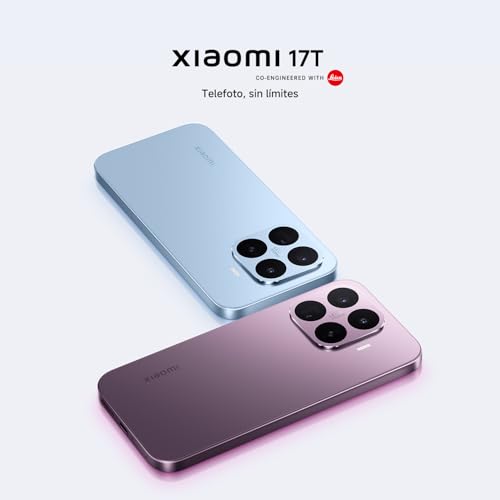
The Xiaomi 17T is a smartphone from Xiaomi's T series, released on May 28, 2026. It features a MediaTek Dimensity 8500-Ultra processor built on a 4 nm process, a 6.59-inch display with a peak brightness of 3,500 nits and a 120 Hz refresh rate, a 6,500 mAh silicon-carbon battery, and runs on Android 16 with the Xiaomi HyperOS 3 interface. Its 200 g weight and 8.17 mm thickness position it in the upper mid-range segment, with an emphasis on battery endurance and sustained performance.
Quick facts
Summary
Basic details and key specifications, selected for the product type.
- Brand
- Xiaomi
- Product type
- Smartphone
- Updated
- Display size
- 6.59 in
- Resolution class
- 1.5K
- Refresh rate
- 120 Hz
- Profile weight
- 200 g
- Dimensions
- 157.6 × 75.2 × 8.17 mm
- Profile height
- 157.6 mm
- Profile width
- 75.2 mm
- GPU
- Mali-G720 MC8
- RAM
- 12 GB
- RAM type
- LPDDR5X
- Storage
- 256 GB
- Storage standard
- UFS
- Wired charging power
- 67 W
- Anode material
- Silicon-carbon
- Camera resolution
- 32 MP / 50 MP / 12 MP
- Aperture
- f/1.7
- Optical zoom
- 5 x
- Front camera
- 32 MP
- 5G bands
- N1, N2, N3, N5, N7, N8, N12, N20, N26, N28, N34, N38, N39, N40, N41, N48, N66, N71, N75, N77, N78
- Wi-Fi standards
- 802.11a, 802.11b, 802.11g, Wi-Fi 4, Wi-Fi 5, Wi-Fi 6, Wi-Fi 6E
- Bluetooth
- Bluetooth 6.0, LE, A2DP
- Skin version
- 3
Article
Detailed Xiaomi 17T review
Introduction and Launch Context
The Xiaomi 17T is a smartphone manufactured by Xiaomi that was added to the company's catalogue on May 28, 2026. Since its publication, the device has been in available status, meaning it can already be purchased by end users without pre-sale restrictions or waitlists.
One of the defining characteristics of this launch is its nature as a global version: the device is not limited to a specific regional market but is prepared to operate across multiple territories with the corresponding network bands and software services. Furthermore, the Xiaomi 17T is distributed as an unlocked device, meaning it carries no carrier lock. The buyer can choose whichever mobile carrier they prefer for their line, switch carriers at any time, or even use the device for data only, without the hardware being conditioned by a service contract.
Within Xiaomi's product strategy, the 17T occupies a specific place in the T line, a branch of the brand that sits above the standard numeric series and typically incorporates a set of specifications aimed at delivering a higher level of performance and build quality within the upper mid-range segment. The "T" suffix in the model name identifies precisely this hierarchical position, distinguishing it from the base series of the same numeric generation.
As a whole, the Xiaomi 17T enters the market as a global, unlocked, and already available smartphone, designed for users who are looking for a T-line device without the limitations inherent to a carrier-locked phone or one restricted to a specific geographic region.
Design and Physical Characteristics
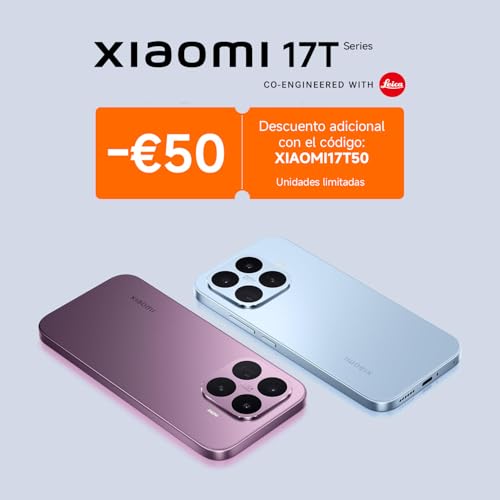
The Xiaomi 17T adopts a compact enclosure that places it squarely in the mid-size smartphone category. Its three-axis dimensions are as follows:
| Dimension | Value |
|---|---|
| Height | 157.6 mm |
| Width | 75.2 mm |
| Thickness | 8.17 mm |
At 200 g, the device sits comfortably within the typical weight range for a smartphone of this screen size. The combination of a 75.2 mm width and a 157.6 mm height allows a secure one-handed grip without the phone extending beyond the palm, while the 8.17 mm thickness keeps the overall profile slim enough to slide easily into a pocket or a bag.
The 89.76 % screen-to-body ratio indicates that the visible display occupies the vast majority of the front surface, reducing the perimeter bezels to a minimum. This figure, combined with the restrained dimensions, positions the Xiaomi 17T in a balanced zone between the visual immersion the panel delivers and the physical manageability of the device: the user perceives a wide screen without the phone gaining disproportionate weight or thickness.
Display and Panel Protection
The Xiaomi 17T features a 6.59-inch panel covering an area of 106.4 cm². This size places it in the mid-range of current smartphones, offering a generous viewing surface without exceeding the dimensions that make one-handed use difficult.
Pixel density is set at 460 ppi, a figure that ensures crisp rendering of text and graphical elements at typical reading distances. The panel's refresh rate reaches 120 Hz, translating into smoother frame-to-frame transitions while scrolling through interfaces, browsing the web, and playing motion content.
Brightness and High Dynamic Range Formats
The panel's peak brightness reaches 3,500 nits, a figure aimed at maintaining legibility under direct sunlight and reinforcing luminance peaks in high-contrast scenes. In terms of high dynamic range compatibility, the device supports two formats: Dolby Vision and HDR10+, allowing playback of audiovisual material with a wider tonal range and greater brightness depth than standard HDR.
Front Glass Protection
The front of the device is covered by Corning Gorilla Glass 7i, the 7i generation of the Gorilla Glass family manufactured by Corning. This protective glass is designed to resist scratches and everyday micro-impacts, adding a layer of durability to the panel without contributing noticeable thickness to the enclosure.
| Feature | Value |
|---|---|
| Display size | 6.59 in |
| Display area | 106.4 cm² |
| Pixel density | 460 ppi |
| Refresh rate | 120 Hz |
| Peak brightness | 3,500 nits |
| HDR formats | Dolby Vision, HDR10+ |
| Panel protection | Corning Gorilla Glass 7i |
Processing Platform
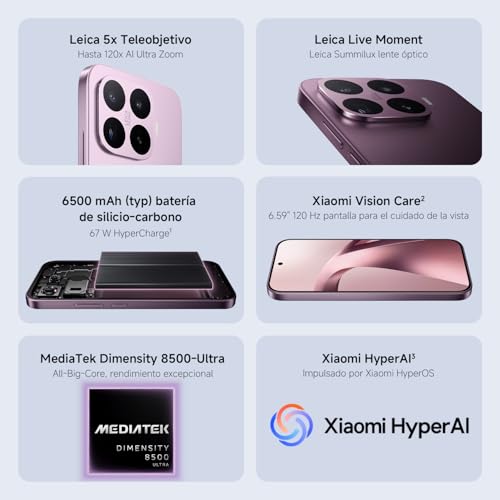
The Xiaomi 17T is powered by the MediaTek Dimensity 8500-Ultra, a system-on-chip (SoC) belonging to the Dimensity family from the Taiwanese manufacturer MediaTek. This integrated package combines the CPU, GPU, neural processing unit, and memory and connectivity controllers on a single die, enabling coordinated management of computation, graphics, and artificial-intelligence acceleration tasks.
The Dimensity 8500-Ultra is fabricated on a 4 nm process node. This lithographic process places the chip among the most advanced generations of commercial manufacturing, translating into a higher transistor density per square millimetre. In practice, that density allows more functional circuits to be packed onto the same silicon surface while simultaneously reducing leakage current, and therefore power consumption at idle and under moderate load.
CPU Architecture
The SoC's central processing unit is composed of 8 cores arranged in a cluster configuration. The core architecture is based on the Cortex-A725 microarchitecture, a high-performance design that MediaTek has adapted to balance per-thread compute throughput with energy efficiency. The presence of eight cores allows the operating system to distribute workloads: background and low-priority tasks are assigned to cores optimised for power consumption, while demanding operations — compilation, rendering, gaming, or video processing — are routed to the higher-frequency cores.
Neural Processing Unit
For workloads associated with advanced processing, the Dimensity 8500-Ultra integrates the NPU 880, a dedicated neural processing unit. This block specifically accelerates neural-network inference tasks such as scene recognition in the camera, real-time noise reduction, object segmentation, and local voice assistants, without relying exclusively on the CPU or GPU. Offloading these operations to specialised hardware reduces response latency and frees general-purpose compute capacity for the remaining applications.
Taken as a whole, the combination of a 4 nm node, eight Cortex-A725 cores, and the NPU 880 positions the Dimensity 8500-Ultra in the upper-mid-range segment, offering sufficient performance headroom for intensive daily use and advanced processing-accelerated tasks, with a power-consumption profile consistent with the battery-life demands of a device of this calibre.
Memory and Internal Storage
The Xiaomi 17T uses LPDDR5X as its working-memory technology. LPDDR5X is a low-power, high-bandwidth generation of DRAM that allows the operating system and background applications to retain their state without repeatedly reloading data. The verified reference configuration for this model specifies 12 GB of LPDDR5X, a capacity that provides a comfortable margin for multitasking: a considerable number of applications can remain active simultaneously before the memory manager needs to free processes.
For persistent data, the device employs UFS (Universal Flash Storage) as its non-volatile storage standard. Compared with the older eMMC generation, UFS delivers significantly higher sequential and random read/write throughput, which translates into shorter application launch times, faster file transfers, and a more responsive system when accessing locally stored data. The verified reference configuration lists 256 GB of UFS storage.
| Component | Verified capacity | Technology / Standard |
|---|---|---|
| Working memory (RAM) | 12 GB | LPDDR5X |
| Internal storage | 256 GB | UFS |
The pairing of LPDDR5X working memory with UFS storage places the data-access path in a tier that comfortably covers everyday workloads — web browsing, messaging, photography, media playback, and a moderate application library — without requiring, in most scenarios, external storage to manage available space. The high bandwidth of LPDDR5X and the parallel-channel architecture of UFS work together to keep the system responsive even when multiple applications and services compete for memory and I/O simultaneously.
Camera System
The Xiaomi 17T features a 32 MP front-facing sensor, a resolution that places the self-portrait module in the upper tier of the mid-to-upper segment. This level of detail is sufficient for selfies and video calls even under moderate lighting conditions.
On the rear, the device carries a triple-camera setup. This three-sensor architecture is the standard configuration across Xiaomi's T line, designed to cover a range of focal lengths and give the user varied framing options—from wide-angle shots to closer perspectives—without the need to switch devices.
Battery and endurance
The Xiaomi 17T incorporates a battery with a nominal capacity of 6500 mAh, a figure that places the device in the upper tier of current smartphones and that, in practice, translates into a prolonged usage window between charges. This capacity is paired with a chemistry choice that goes beyond simple energy accumulation.
The cell employs a silicon-carbon lithium-ion chemistry. Unlike conventional lithium-ion batteries, whose anode is composed entirely of graphite, this variant partially substitutes carbon with silicon in the anode structure. Silicon possesses a theoretical lithium-ion storage capacity significantly higher than that of graphite, allowing more energy to be packed into the same physical volume. In practical terms, this translates into a higher energy density: the 6500 mAh battery of the Xiaomi 17T occupies a space comparable to what a lower-capacity conventional lithium-ion cell would require.
Beyond the density gain, the incorporation of silicon in the anode contributes to a more favourable cycle life. Pure-graphite lithium-ion cells undergo progressive capacity degradation after a certain number of charge and discharge cycles; the presence of silicon in the anode matrix mitigates part of that loss, so the battery retains a higher percentage of its nominal capacity over a greater number of cycles. For the user, this manifests as an endurance that holds up more steadily as months of daily use accumulate.
Altogether, the combination of a 6500 mAh capacity with the silicon-carbon chemistry positions the Xiaomi 17T's battery as a component designed to extend the time between charges without disproportionately increasing the device's thickness or weight, while simultaneously targeting a slower degradation rate than that of pure-graphite lithium-ion cells.
Connectivity and network compatibility
The Xiaomi 17T incorporates a set of cellular technologies spanning all four generations of mobile networks: GSM (2G), HSPA (3G), LTE (4G), and 5G. This multigenerational coverage ensures the device can connect to any carrier's infrastructure, from basic voice and data networks to next-generation networks offering higher bandwidth and lower latency.
Frequency bands by generation
The breadth of supported bands is one of the most relevant aspects for a globally sold device, as it determines compatibility with the spectrums allocated in each region. The following table details coverage by technology:
| Generation | Supported bands |
|---|---|
| 2G (GSM) | 850, 900, 1800, and 1900 MHz |
| 3G (HSPA) | 800, 850, 900, 1700, 1900, and 2100 MHz |
| 4G (LTE) | B1, B2, B3, B4, B5, B7, B8, B12, B13, B17, B18, B19, B20, B26, B28, B32, B34, B38, B39, B40, B41, B42, B48, B66, and B71 |
| 5G (NR) | n1, n2, n3, n5, n7, n8, n12, n20, n26, n28, n34, n38, n39, n40, n41, n48, n66, n71, n75, n77, and n78 |
The inclusion of bands such as B28/n28 (700 MHz) and B71/n71 (600 MHz) is particularly useful in markets where low-frequency coverage is the primary means of reaching rural or indoor areas. Likewise, the presence of TDD bands such as B41/n41 (2.5 GHz) and B42/n42 (3.5 GHz) ensures compatibility with high-capacity 5G deployments in dense urban environments.
SIM configuration
The device supports two subscriber identification formats: a physical Nano-SIM and a digital eSIM. It features two physical slots for Nano-SIM cards and support for one eSIM, allowing two active lines simultaneously. This combination offers the user several practical configurations:
- Two physical Nano-SIM cards to operate with two different carriers.
- One physical Nano-SIM plus one eSIM, useful for separating a personal line from a corporate one or for adding a local line while travelling without swapping cards.
- Two eSIMs (where the carrier permits) for fully digital line management.
The availability of eSIM expands usage flexibility in markets where carriers already offer digital portability and simplifies activating a second line without manipulating the physical slot. Taken together, the 25 LTE bands and 21 5G bands, along with the dual physical slots and eSIM support, position the Xiaomi 17T as a device prepared for broad international use, with homogeneous coverage across Europe, the Americas, Asia, and Oceania.
Operating System and Customization Layer
The Xiaomi 17T ships out of the box with Android 16 as its base operating system. This version of Google's platform forms the core upon which the entire user experience is built: application management, permissions, security, and compatibility with the broader Android services ecosystem.
On top of that foundation, Xiaomi applies its own customization layer, Xiaomi HyperOS 3 (version 3). HyperOS is the manufacturer's proprietary interface and suite of services that reconfigure the visual appearance, home-screen organization, system utilities, and cross-device connectivity features across the brand's product line. The "3" in the designation indicates that this is the third major iteration of the layer, placing the device within Xiaomi's most recent software generation.
In practice, the user interacts with Android 16 through the HyperOS 3 interface: Google and third-party applications run on the Android framework, while navigation, personalization settings, and the manufacturer's built-in tools are managed from the HyperOS layer. This combination defines the device's out-of-the-box software and serves as the starting point from which subsequent updates will be delivered.
Technical Assessment
The Xiaomi 17T is positioned as a device whose overall technical specification set targets the upper-mid segment of the market. To gauge its profile, it is useful to examine how its key parameters interact: the processor manufacturing node, the visual panel characteristics, the battery architecture, and the physical integration of the assembly.
Key parameters at a glance
| Parameter | Value |
|---|---|
| SoC manufacturing process | 4 nm |
| Primary core architecture | Cortex-A725 |
| Neural processing unit | NPU 880 |
| Peak display brightness | 3,500 nits |
| Pixel density | 460 ppi |
| Refresh rate | 120 Hz |
| Battery capacity | 6,500 mAh |
| Battery chemistry | Silicon-carbon lithium-ion |
| Weight | 200 g |
| Screen-to-body ratio | 89.76 % |
Processing platform
The processor is fabricated on a 4 nm node, a lithography scale that allows a greater number of transistors to be integrated within the same silicon surface area, translating into higher energy efficiency per operation. The primary core architecture, Cortex-A725, defines the behaviour of the most demanding tasks, while the NPU 880 handles inference and signal-processing workloads in a dedicated fashion, freeing the CPU and GPU from operations that would otherwise consume additional cycles. The coexistence of an advanced node, an updated core architecture, and a dedicated neural unit forms a technical triangle that places the platform at the upper end of what is expected in the upper-mid segment.
Visual panel
The peak brightness of 3,500 nits is a relevant figure under intense outdoor lighting, where content legibility depends directly on the panel's ability to outshine ambient luminance. The 460 ppi density provides sufficient sharpness for the majority of typical viewing distances, and the 120 Hz refresh rate reduces perceived motion during scrolling and animations, a parameter that has become the fluidity benchmark in the upper-mid segment. The combination of these three values — brightness, density, and refresh rate — determines the device's overall visual experience.
Battery and energy density
The 6,500 mAh cell adopts a silicon-carbon lithium-ion chemistry, as opposed to conventional graphite-based lithium-ion. Replacing the graphite anode with a silicon-carbon matrix increases the energy density per unit of volume, allowing greater capacity to be housed without a proportional increase in the device's thickness. In practice, the direct implication is longer endurance per charge cycle and a more gradual degradation over the battery's useful life, two factors the user perceives as a battery that retains its performance over a longer period.
Physical integration
At 200 g and a screen-to-body ratio of 89.76 %, the device achieves a wide viewing surface within a chassis that does not cross the psychological threshold of 200 grams. This proportion indicates that the perimeter bezels are narrow, maximising the panel's usable area without compromising one-handed handling. The balance between battery capacity, manufacturing node, and total weight reflects an engineering decision aimed at concentrating component density without penalising ergonomics.
Synthesis
The Xiaomi 17T's specification set — 4 nm node, 3,500-nit brightness, 120 Hz refresh rate, 6,500 mAh silicon-carbon lithium-ion battery, NPU 880, and 200 g weight — describes a technical profile consistent with the expectations an upper-mid-segment user associates with a device designed for a prolonged service life. No single parameter is exceptional in isolation, but the coherence among them, and the absence of evident compromises in areas such as pixel density or refresh rate, configure a device whose out-of-the-box specifications align with the technical standard the segment has been consolidating over recent product cycles.
Evidence-backed content
Sources consulted for Xiaomi 17T
Documents supporting the information published in this article.
- Xiaomi 17T: New certifications reveal some of the specifications of the new series - News by Xiaomi Miui Hellas en.xiaomi-miui.gr/xiaomi-17t-new-certifications-reveal-some-of-series-sp...
- Xiaomi 17T and 17T Pro: Review, Specs, and Price in 2026 - Xiaomi for All xiaomiforall.com/xiaomi-17t-and-17t-pro-review-specs/
- Xiaomi 17T - tuxiaomi.es tuxiaomi.es/moviles/xiaomi-17t/
- Xiaomi 17T Pro - tuxiaomi.es tuxiaomi.es/moviles/xiaomi-17t-pro/
- Nuevos Xiaomi 17T y 17T Pro: Xiaomi rompe con el límite con la mayor batería vista en toda la marca www.mundoxiaomi.com/moviles/nuevos-xiaomi-17t-17t-pro-xiaomi-rompe-limit...
- XIAOMI 17T (negro, 12 GB + 512 GB) | Cámaras Leica Flagship | Óptica Leica UltraPure | Segment Best Leica 5X Zoom óptico | Zoom advanced processing de 120X | Pantalla AMOLED de 16,74 cm (6,59 pulgadas) 120 Hz | 3500 www.amazon.es/dp/B0GYX3PVWJ?tag=kaicus-21&linkCode=ogv&th=1&psc=1
- XIAOMI 17T, Smartphone 12+256GB, Violeta www.amazon.es/dp/B0H45LRBY6?tag=kaicus-21&linkCode=osi&th=1&psc=1
- XIAOMI 17T, Smartphone 12+256GB, Negro www.amazon.es/dp/B0H45BKMK2?tag=kaicus-21&linkCode=osi&th=1&psc=1
- XIAOMI 17T Smartphone de 12+256GB Azul Teleobjetivo Leica 5X www.amazon.es/dp/B0GS684M4B?tag=kaicus-21&linkCode=ogv&th=1&psc=1
- XIAOMI 17T Smartphone 12GB+256GB - Teléfono móvil con Android, 6,59 pulgadas, 120 Hz, pantalla Eye-Care de 6500 mAh, batería de silicio de carbono, cámara Leica 5X, color morado www.amazon.es/dp/B0H376GXL2?tag=kaicus-21&linkCode=osi&th=1&psc=1
- XIAOMI 17T Smartphone 12+256GB, Violeta www.amazon.es/dp/B0H6FN97H1?tag=kaicus-21&linkCode=osi&th=1&psc=1
- XIAOMI 17T Smartphone de 12+256GB Violeta Teleobjetivo Leica 5X www.amazon.es/dp/B0GS6C584C?tag=kaicus-21&linkCode=ogv&th=1&psc=1
- XIAOMI 17T, Smartphone 12 + 256 GB, Pantalla Eye-Care de 6,59 pulgadas hasta 120 Hz, Batería de silicio-carbono de 6500 mAh (tipo), Teleobjetivo Leica 5x, HyperCharge 67 W, Púrpura www.amazon.es/dp/B0H394X24F?tag=kaicus-21&linkCode=osi&th=1&psc=1
- XIAOMI 17T Smartphone 12GB+256GB - Móvil con Android, pantalla de 6,59 pulgadas 120Hz Eye-Care, batería de 6500mAh Silicio-Carbono, cámara Leica 5X Tele, Negro, incluye cargador de 67W www.amazon.es/dp/B0H392MW3N?tag=kaicus-21&linkCode=osi&th=1&psc=1
- XIAOMI 17T 12+256GB Móvil, Cámara Leica 50MP con OIS, Teleobjetivo 5X, AMOLED 6.59" 120Hz 1.5K 3500nits, Batería 6500mAh, IP68, MediaTek Dimensity 8500-Ultra, Negro, No Incluye Cargador www.amazon.es/dp/B0H36WZL14?tag=kaicus-21&linkCode=osi&th=1&psc=1
- XIAOMI 17T 12+256GB Móvil, Cámara Leica 50MP con OIS, Teleobjetivo 5X, AMOLED 6.59" 120Hz 1.5K 3500nits, Batería 6500mAh, IP68, MediaTek Dimensity 8500-Ultra, Púrpura, No Incluye Cargador www.amazon.es/dp/B0H371Q2FW?tag=kaicus-21&linkCode=osi&th=1&psc=1
- XIAOMI 17T Pro Smartphone 12+512GB, Black www.amazon.es/dp/B0H6FBYYWX?tag=kaicus-21&linkCode=osi&th=1&psc=1
- XIAOMI 17T Smartphone 12+256GB, Violeta, Includes 120W Charger www.amazon.es/dp/B0H6FHK5CD?tag=kaicus-21&linkCode=osi&th=1&psc=1
- XIAOMI 17T Smartphone de 12+256GB Negro Teleobjetivo Leica 5X www.amazon.es/dp/B0GS6C6FP1?tag=kaicus-21&linkCode=osi&th=1&psc=1
- XIAOMI 17T 12+256GB Móvil, Teleobjetivo 5X hasta 120X Zoom, AMOLED 6.59" 120Hz 1.5K, 6500mAh, IP68, MediaTek Dimensity 8500-Ultra, Negro, No Incluye Cargador,Included Headphones (Blue) www.amazon.es/dp/B0H3LLN4ZN?tag=kaicus-21&linkCode=osi&th=1&psc=1
- XIAOMI 17T Smartphone 12+512GB 6.59" AMOLED 5G BLACK 6500mAh Dual SIM NFC EU www.ebay.es/itm/800182920954?_skw=Xiaomi+17T&hash=itemba4e9e66fa:g:rHIAA...
- leica-camera.com leica-camera.com/sites/default/files/2026-05/prefix-0/Press-Release_Xiao...
- leica-camera.com leica-camera.com/sites/default/files/2026-05/Comunicato-stampa_Xiaomi-e-...
- Marca Modelo Nombre comercial Apple A2101 iPhone Xs MAX ... d30pw3v00l104c.cloudfront.net/website/pdf/TerminaleshomologadoseSIM.pdf
- Xiaomi 17 vs Xiaomi 17T : Specs Comparison, Price Difference | 91mobiles.com www.91mobiles.com/compare/Xiaomi/17/vs/Xiaomi/17T.html
- Xiaomi 17T Review - Pros and cons, Verdict | 91Mobiles www.91mobiles.com/reviews/xiaomi-17t-review/
- Xiaomi 17T - Full phone specifications www.gsmarena.com/xiaomi_17t_5g-14652.php
- Xiaomi 17T - Notebookcheck Reviews Collection www.notebookcheck.net/Xiaomi-17T.1310964.0.html
- Xiaomi 17T review: a supremely capable Android phone with a decent price | TechRadar www.techradar.com/phones/xiaomi-phones/xiaomi-17t-review
- Xiaomi 17T - Wikipedia en.wikipedia.org/wiki/Xiaomi_17T
- Xiaomi 17T Series Clears FCC: 17T Gets 6360mAh Battery, 100W Charging; 17T Pro Brings WiFi 7, Reverse Charging, 1TB Storage - The Tech Outlook www.thetechoutlook.com/tech-whispers/xiaomi-17t-series-clears-fcc-17t-ge...
- Xiaomi 17T and 17T Pro head for global release as certification emerges - Notebookcheck News www.notebookcheck.net/Xiaomi-17T-and-17T-Pro-head-for-global-release-as-...
- Xiaomi 17T and 17T Pro Design Revealed via Anatel Certification - XimiTime ximitime.com/xiaomi-17t-and-17t-pro-design-revealed-via-anatel-certifica...
- Xiaomi 17T Pro - Full phone specifications www.gsmarena.com/xiaomi_17t_pro_5g-14651.php
- Xiaomi 17T - Full Specifications, Official Price & Expert Rating www.gadgetbytenepal.com/product/xiaomi-17t/
- Xiaomi 17T 2602DPT53G, 2602DPT53I technical specifications :: GSMchoice.com www.gsmchoice.com/en/catalogue/xiaomi/17t/
- Xiaomi 17T 5G Dual Sim 12GB RAM 256GB Blue MZB0NOTEU – Buy Online dakauf.eu/en/product/xiaomi-17t-5g-dual-sim-12gb-ram-256gb-blue/
- Xiaomi 17T Full Specifications - PhoneArena www.phonearena.com/phones/Xiaomi-17T_id12980
- Xiaomi 17T - Specifications www.devicespecifications.com/en/model/1ff96766
- Xiaomi 17T - Full Specifications, Price & Review | Mobolist www.mobolist.net/en/devices/xiaomi-17t
Structured data
Xiaomi 17T technical specifications
Specifications are kept separate from the editorial narrative, making them easy to consult without interrupting the reading experience.
Variants
Variants of Xiaomi 17T
A single page covers every commercial version. The table shows only specifications that differ between them.
256 GB - Azul
- Model
- 17T
- EAN / GTIN
06932554448097
256 GB - Violeta
- Model
- 17T
- EAN / GTIN
00190997071371
256 GB - Negro
- Model
- 17T
- EAN / GTIN
06932554448417
512 GB - Blanco
- Model
- —
- EAN / GTIN
—
512 GB - Violeta
- Model
- —
- EAN / GTIN
06932554447991
| Difference | Xiaomi 17T 12 GB / 256 GB Azul | Xiaomi 17T 12 GB / 256 GB Morado | Xiaomi 17T 12 GB / 256 GB Negro | Xiaomi 17T 12GB/512GB Blanco | Xiaomi 17T 512 GB Violeta |
|---|---|---|---|---|---|
| Color | Blue | — | — | — | Violet |
| Canonical base color | Blue | — | — | — | Purple |