Infinix Note 60
The Infinix Note 60 is a smartphone from Infinix Mobile's Note series, targeted at the global market, combining a 6.78-inch AMOLED display with a 240 Hz touch sampling rate, a 4 nm processor with a dedicated NPU, a dual-camera system with optical image stabilization, and 5G connectivity limited to two bands. Its construction incorporates Gorilla Glass 7i and an aluminum chassis with IP64 certification, and it ships with Android 16 preinstalled.
Quick facts
Summary
Basic details and key specifications, selected for the product type.
- Brand
- Infinix
- Product type
- Smartphone
- Updated
- RAM
- 8 GB
- 5G bands
- N1, N2
- Wi-Fi standards
- 802.11a, 802.11b, 802.11g, Wi-Fi 4, Wi-Fi 5
Article
Detailed Infinix Note 60 review
Product Introduction and Context
The Infinix Note 60 belongs to the Note line from Infinix Mobile, a branch of the brand's catalogue oriented toward offering devices that strike a balance between performance and accessibility. Within that family, the Note 60 is positioned as a current reference that Infinix targets at the global market, meaning a distribution that transcends a single territory and implies the availability of the device in multiple regions with the same factory specifications.
Before delving into the technical detail of each subsystem, it is worth noting an identification data point that accompanies the unit from the moment of purchase: the Infinix Note 60 ships with a 2-year manufacturer warranty. This coverage period, granted directly by Infinix, protects the device against manufacturing defects during the first two years from the date of acquisition and serves as a reference point for the user evaluating the after-sales protection associated with the product.
With these two framing data points — its membership in the Note line and its two-year global warranty — the necessary context is established to address, in the sections that follow, the design, display, processing platform, camera system, connectivity, energy management, and software that define the user experience of the Infinix Note 60.
Design, Materials, and Durability
The Infinix Note 60 adopts a compact geometry for its segment, measuring 162.4 mm in height and 77.2 mm in width. These dimensions place the device in the mid-size terminal range, making it easy to grip with one hand and reducing the perceived volumetric weight compared to larger models in the same tier.
The material selection follows a criterion of lightness and structural rigidity. The front is protected by Gorilla Glass 7i, a corundum-based glass that increases resistance to scratches and point impacts relative to earlier generations of tempered glass. Both the perimeter frame and the back panel are made of aluminum, an alloy that offers a good balance between torsional rigidity and mass, while also facilitating passive heat dissipation from the internal platform. The combination of glass on the visible face and metal across the entire chassis eliminates the need for structural plastics, translating into a solid tactile feel and a longer lifespan under light body flexion.
Water and Dust Protection
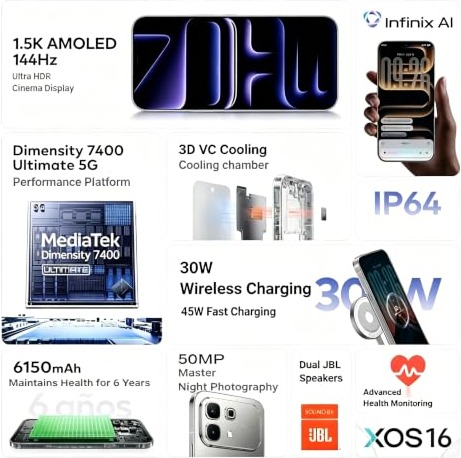
The device carries an IP64 resistance rating. The first digit, 6, indicates complete sealing against dust intrusion: no particle accumulation occurs that could interfere with internal mechanisms. The second digit, 4, certifies protection against water splashes from any direction, meaning the terminal withstands low-intensity water jets for a limited period without liquid reaching the electronic components. This certification covers everyday situations such as moderate rain or accidental splashes, but does not account for submersion in water or exposure to high-pressure jets.
Display and Visual Experience
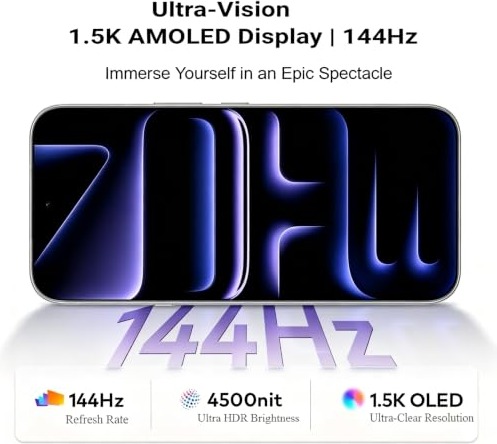
The Infinix Note 60 features a 6.78-inch AMOLED panel. AMOLED technology works by having each pixel emit its own light independently, eliminating the need for a rear backlight. This translates to true blacks, high contrast ratios, and superior energy efficiency compared to conventional LCD panels, since pixels representing the colour black are simply switched off. Within the mid-range segment, an AMOLED panel of this size delivers an immersive visual experience for both video consumption and extended text reading.
The pixel density stands at 429 ppi (pixels per inch). At a normal viewing distance, this value ensures that the human eye cannot distinguish the individual dots that make up the image. The result is crisp text, well-defined icon edges, and image reproduction free from the pixelation artefact that can be noticeable on lower-resolution panels.
A parameter that directly affects the perceived sense of fluidity is the touch sampling rate, which on this device reaches 240 Hz. This means the panel registers the position of a finger 240 times per second. In practice, the response to every gesture — a swipe, a zoom, a rapid tap in a game — is perceived with minimal latency, reducing the sense of delay between the user's movement and the visual reaction on screen.
The panel surface is protected by Corning Gorilla Glass 7i, a generation of Corning's reinforced glass engineered to resist scratches and micro-impacts from everyday use. The presence of this protection lowers the likelihood that contact with keys, coins, or rough surfaces will degrade image clarity over time.
The screen-to-body ratio is set at 89.4 %, indicating that the majority of the front surface is occupied by the active display area. The perimeter bezels remain narrow, favouring a sense of immersion and making the most of the available space on the device's front face.
The panel is touch-sensitive, enabling full interaction with the operating system through single-finger gestures, multi-touch input, and swiping, without the need for physical buttons on the front surface.
Processing Platform and Thermal Management
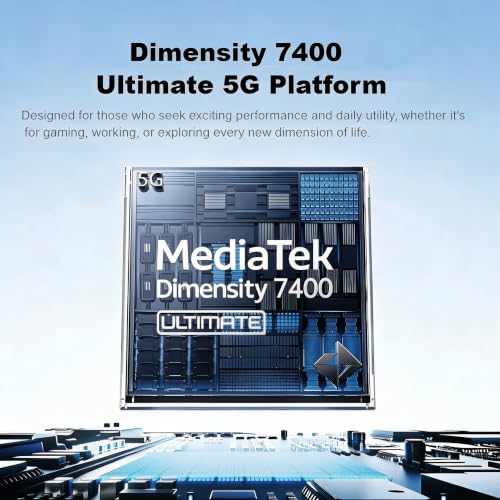
The Infinix Note 60 incorporates an 8-core processor manufactured on a 4 nm node. This multicore architecture distributes workloads across execution units dedicated to performance and efficiency, so that background operations (synchronization, notifications, media playback) are handled by low-power cores while intensive loads — gaming, video editing, multi-tab browsing — are routed to the higher-frequency cores. The 4 nm node reduces leakage current per transistor, which translates into lower thermal dissipation per unit of work executed and, consequently, a higher transistor density within the same silicon area.
The 8 GB of RAM acts as the exchange space between the processor and internal storage. With eight gigabytes available, the operating system can keep a larger number of applications running in the background without forcing frequent reloads from flash, reducing the perceptible latency when switching between tasks. The direct interaction between the eight cores and this memory bank determines the effective bandwidth the platform can sustain during prolonged sessions.
For workloads that require local inference — scene recognition in the camera, voice processing, real-time image optimization — the device integrates the MediaTek NPU 655. This neural processing unit executes matrix operations in parallel and with lower energy consumption than the CPU or GPU would demand for the same task, freeing cycles from the general-purpose cores for the rest of the system's functions.
Thermal management relies on a vapor chamber, a flat sealed structure containing a small amount of refrigerant liquid. When a core or the NPU exceeds a temperature threshold, the liquid evaporates, carries the heat toward the cooler zones of the chamber, and condenses there, returning to the point of origin by capillarity. This continuous cycle keeps component temperatures within safe ranges during sustained loads, preventing premature throttling that would reduce clock frequency and, with it, the available performance.
As a whole, the combination of a 4 nm node, eight cores, 8 GB of RAM, the dedicated NPU, and the vapor chamber configures a platform oriented toward sustaining mixed workloads — multitasking, computational photography, and gaming sessions — without thermal dissipation or memory capacity becoming the limiting factor during everyday use.
Internal Storage
The Infinix Note 60 ships with 128 GB of internal storage based on the UFS 2.2 (Universal Flash Storage, generation 2.2) standard. This interface places the component in the mid-to-upper range of data-access speeds within the UFS family, above the eMMC memory still found in some entry-level devices.
| Parameter | Value |
|---|---|
| Capacity | 128 GB |
| Standard | UFS |
| Generation | UFS 2.2 |
| Card expansion | Not available |
The device has no microSD card slot or any other external expansion mechanism. The 128 GB of internal storage is therefore the maximum space available for applications, photographs, video, and multimedia files over the entire lifespan of the device. The only way to free up space will be deleting local data or backing it up to cloud storage services.
This lack of expandability has direct practical consequences: the user must assess their storage needs before purchase, since the operating system and preinstalled applications occupy a fixed portion of the total from the very first boot. For intensive photography or high-resolution video recording, the available headroom shrinks in proportion to the volume of content generated locally.
In terms of performance, the UFS 2.2 interface delivers higher sequential read and write speeds than eMMC memory, translating into faster application load times, package installations, and file transfers, within the expectations of the segment in which the Infinix Note 60 is positioned.
Photography and Video System
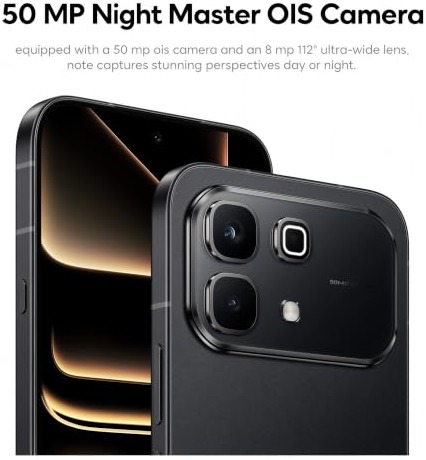
The Infinix Note 60 features a rear camera system composed of two sensors: a 50 MP main camera and an 8 MP ultrawide lens. This dual-lens configuration covers the two most common framing ranges in mobile photography: the standard focal length for portraits, everyday scenes, and documents, and the wide field of view for landscapes, architecture, or indoor spaces where shooting distance is insufficient.
Rear Camera Configuration
- Main camera: 50 MP, designed for high-resolution captures with enough detail for subsequent cropping without noticeable loss of sharpness.
- Ultrawide lens: 8 MP with a focal length of 15 mm, providing a very wide field of view and proving useful for scenes where the standard framing does not reach far enough.
The 15 mm focal length of the ultrawide sensor places its field of view above that of conventional mid-range wide-angle lenses (which typically fall in the 18–22 mm range), allowing more context to be captured in a single shot. In return, the 8 MP resolution of this second sensor is lower than that of the main camera, an engineering decision consistent with the sensor size and the amount of light a lens of such a wide aperture can gather.
Optical Image Stabilization
The system includes optical image stabilization (OIS), a physical mechanism that compensates for hand micro-movements through the controlled displacement of the optical assembly. Its presence in a device of this tier is significant because it reduces motion blur in low-light shots or with longer exposure times, and it contributes to a higher rate of usable captures without the need for post-processing cropping.
Front Camera
On the front, a 13 MP sensor is positioned for selfies, video calls, and social media content capture. The resolution is sufficient to produce sharp images under adequate lighting conditions and to maintain an acceptable level of detail in standard-resolution video calls.
Capture Features
The available feature set includes:
- Dual LED flash: two illumination diodes that allow better balancing of artificial light on the subject and reduce harsh shadows compared to a single flash unit.
- HDR (High Dynamic Range): combination of multiple exposures into a single image to preserve detail in both the brightest and darkest areas of the scene.
- Panorama: capture of extended scenes by sweeping the device horizontally or vertically, stitching multiple frames into a single wide image.
Video Recording
The device supports video recording at a maximum resolution of 2160p (4K), which quadruples the pixel count per frame compared to the standard Full HD (1080p) format. This resolution offers greater headroom for cropping in post-production and superior sharpness on large displays, though it demands higher write bandwidth from the storage and more intensive processing from the platform.
Connectivity, Networks, and Telecommunications
The Infinix Note 60 incorporates a set of wireless and wired interfaces designed to cover everyday communication, data transfer, and control of external devices. Each connectivity block is detailed below.
Wireless Standards
For local network connectivity, the device supports the 802.11a, 802.11b, and 802.11g standards, which correspond to the designations Wi-Fi 4 (2.4 GHz) and Wi-Fi 5 (5 GHz). Wi-Fi 6 and Wi-Fi 6E support is not included, so the maximum link rate is limited to the rates inherent to 802.11ac in the 5 GHz band.
Short-range connectivity is handled by Bluetooth 5.4 with support for Low Energy (LE) and the A2DP profile, allowing pairing of headphones, speakers, and peripherals with lower power consumption than previous generations. Additionally, the phone integrates an NFC module that enables contactless payments, short-range data exchange, and smart tag activation.
Physical Ports and Auxiliary Functions
- USB Type-C 2.0 with OTG: the reversible connector supports both charging and data transfer as well as direct connection of USB peripherals (memory drives, keyboards, mice) via the On-The-Go function, without the need for adapters.
- Infrared port: the integrated IR emitter allows control of televisions, set-top boxes, air conditioners, and other compatible appliances, acting as a universal remote.
- FM radio: native FM band radio tuning is available, typically using the headphone cable as an antenna.
Mobile Network Bands
The cellular network coverage of the Infinix Note 60 spans all four generations of mobile telephony. The following table summarizes the supported bands for each generation:
| Generation | Bands |
|---|---|
| 2G (GSM) | 850, 900, 1800, 1900 MHz |
| 3G (WCDMA) | 850, 900, 2100 MHz |
| 4G (LTE) | B1, B3, B5, B8, B28, B38, B40, B41 |
| 5G (NR) | n1, n2 |
The inclusion of 4G bands B38, B40, and B41 (TDD-LTE) broadens compatibility with operators deploying networks in TDD spectrum, while B28 (700 MHz) favors indoor penetration and rural coverage. In 5G, support is limited to bands n1 (2100 MHz) and n2 (1900 MHz), both in sub-6 GHz spectrum, which restricts 5G coverage to markets where operators have deployed those specific frequencies.
SIM Configuration
The device supports Nano-SIM and eSIM formats. The physical configuration allows insertion of two Nano-SIMs plus one eSIM, with a maximum of two active lines simultaneously. The operating mode is DSDS (Dual SIM Dual Standby): both lines remain on standby and can receive calls and data, but only one of them can maintain an active data session at any given moment. This architecture simplifies the radio hardware compared to DSDA (Dual SIM Dual Active) and is sufficient for most dual-line use cases.
Audio and Sensors
The Infinix Note 60 features a single speaker in its acoustic configuration. This single-emitter layout covers sound output for notifications, calls, music, and video, though it does not provide the channel separation that a stereo system would offer. For the user, this translates into a functional listening experience oriented toward monophonic playback, sufficient for everyday multimedia consumption and voice communication.
Regarding environmental detection and user interaction, the device integrates a set of five sensors that work in coordination:
- Accelerometer: measures changes in device acceleration across three axes. It allows the operating system to detect orientation changes (switching from portrait to landscape), activate automatic screen rotation, and, together with the gyroscope, compensate for sudden movements during video capture to improve image stability.
- Compass (magnetometer): determines the phone's orientation relative to magnetic north. It facilitates the use of navigation and map applications and provides orientation data that can be integrated into photograph metadata.
- Fingerprint sensor: enables biometric user authentication to unlock the device, authorize payments, or access restricted content, offering a quick and secure alternative to numeric codes.
- Gyroscope: records the angular rotation speed of the phone. Together with the accelerometer, it forms the electronic image stabilization (EIS) system that smooths out shakes in video recordings and in long-exposure still photography.
- Proximity: detects the presence of an object near the front surface, typically the user's face during a call. When triggered, it turns off the screen to prevent accidental touches and skin contact with the glass, while also preserving the visibility of on-screen content.
The combination of accelerometer and gyroscope is particularly relevant for image stability: when capturing video or photographs in low light, the image-processing system uses real-time motion data to apply framing corrections and reduce motion blur. The proximity sensor, for its part, ensures clean interaction with the touch interface during extended use scenarios, such as video calls or holding the phone against the ear while navigating.
Power and Charging
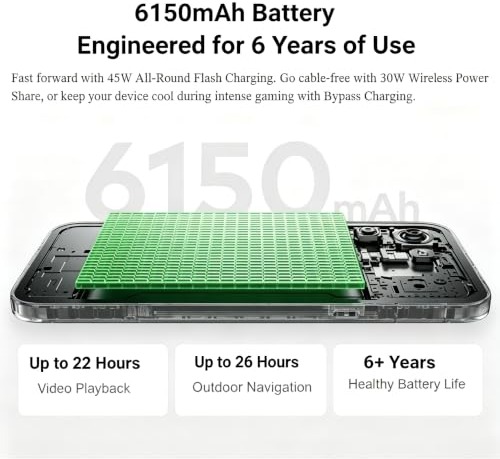
The Infinix Note 60 incorporates two power-delivery mechanisms that complement the device's energy management: bypass charging and wireless charging. Both systems operate independently and can be combined according to the user's needs, offering distinct advantages in terms of thermal dissipation and usage flexibility.
Bypass charging
Bypass charging is a mechanism whereby, while the device is connected to an external power source, energy is routed directly to the main system circuit, bypassing the battery as an intermediary. In practice, when the battery reaches a high charge level or when the device sustains intensive workloads (gaming, video recording, navigation with active GPS), the power controller diverts the charger's current toward the consuming components and prevents the battery from cycling through short intervals of discharge and recharge.
This strategy has two technically relevant consequences:
- Thermal management: by reducing simultaneous charge-discharge cycles, heat generation in the cell pack is limited. The battery, which is one of the most temperature-sensitive elements, operates under a more stable regime, helping to keep the internal temperature of the assembly below the thresholds that would trigger thermal-protection performance throttling.
- Battery life and longevity: by minimising micro-degradation cycles, the battery's nominal capacity is preserved over a longer period. For the user, this translates into sustained battery endurance over months of use, particularly in prolonged-charging scenarios such as gaming sessions or streaming while the device remains connected to the mains.
Wireless charging
The Infinix Note 60 supports wireless charging, that is, the transfer of energy by electromagnetic induction through a transmitter placed on the surface of a compatible charger. The device incorporates a receiver coil in its rear panel that, when aligned with the transmitter's magnetic field, induces an alternating current that the rectification circuit converts into direct current to power the battery or, in combination with bypass mode, the system directly.
Wireless charging offers a direct practical advantage: it eliminates the need for a physical connector and the mechanical wear that such a connector implies on the charging port. From a thermal standpoint, inductive transfer generates a small amount of additional heat at the interface between the receiver coil and the transmitter surface, so the device's power-management system regulates the received power to keep temperatures within safe ranges. However, because this is a moderate-power charge, the thermal increase is limited and is managed without requiring any additional user intervention.
Complementarity of both systems
The coexistence of bypass charging and wireless charging allows the user to select the most appropriate power-delivery regime for each situation. During extended sessions with the device resting on an inductive charging surface, bypass mode can be activated so that energy flows directly to the system, protecting the battery from thermal stress. On the go or in environments where a wireless transmitter is not available, wired charging with bypass fulfils the same protective role. In this way, the Infinix Note 60 offers energy management that prioritises thermal stability and battery preservation without sacrificing the convenience of cable-free charging.
Operating System
The Infinix Note 60 ships with Android 16 as its factory-installed operating system. This is the most recent release of the mobile operating system at the time of the device's launch, placing the phone at the most up-to-date starting point within the Android ecosystem.
In terms of application compatibility, running on a current Android release means the device meets out of the box the API requirements, granular permission model, and security mechanisms that contemporary applications demand for installation and operation, with no need for emulations or intermediary layers.
Regarding the update cycle, debuting with Android 16 maximizes the available time window for receiving security patches and, where applicable, subsequent system iterations before the manufacturer's support period concludes. The user therefore starts from the most recent baseline, which narrows the gap between the device and the versions that will be published in the months following its commercial release.
Technical Assessment
The Infinix Note 60 incorporates a set of engineering decisions that, taken together, define a specific technical profile within the mid-range tier. The following contrasts the principal design choices against what the segment typically offers, without issuing purchase judgments or commercial valuations.
Display and Touch Response
The choice of an AMOLED panel as the viewing surface places the device above the mid-range average, where IPS-LCD panels still predominate. Organic OLED technology enables true blacks, higher contrast, and per-pixel brightness management that reduces power consumption on dark content. This is complemented by a touch sampling rate of 240 Hz, a figure that comfortably exceeds the 120 Hz common in the category and translates into a perceptibly lower finger-response latency, especially in games and when navigating interfaces with fast scrolling.
Manufacturing Node and Thermal Management
The processor is fabricated on a 4 nm node, an architecture that in the upper mid-range segment is traditionally associated with flagship devices. The reduction in transistor size allows greater circuit density per square millimetre and superior energy efficiency compared to 6 or 7 nm nodes, which is reflected in lower power draw at an equivalent workload. To sustain prolonged loads without thermal degradation, the device integrates a vapor chamber as its thermal dissipation system, a mechanism that distributes heat uniformly over a larger surface area than a simple copper plate would. The inclusion of the MediaTek NPU 655 adds a dedicated neural processing unit, oriented toward accelerating local inference tasks such as image processing, video noise reduction, or user-interface optimisation, without relying exclusively on the CPU or GPU for those operations.
Photographic System
The rear configuration consists of a 50 MP main camera and an 8 MP ultrawide. The inclusion of optical image stabilisation (OIS) on the main sensor is an element that is not always present in the mid-range and that allows capturing photographs with reduced vibration in low-light conditions or with longer exposure times. The 8 MP ultrawide offers a wide field of view for landscapes and architecture, although its resolution is lower than that of the main sensor, which limits detail in cropped areas. Taken as a whole, the system covers the two most in-demand viewing angles for the average user, with the added advantage of mechanical stabilisation on the main lens.
5G Connectivity and Protection
5G network support is limited to bands n1 and n2, a coverage that, while functional, is more restricted than that of devices incorporating a greater number of sub-6 GHz bands. This means that the real availability of 5G will depend largely on the operator's deployment in the area of use, since not all 5G networks operate on those two bands. As for environmental resistance, the IP64 certification guarantees full protection against dust ingress and against water splashes from any direction, although it does not contemplate immersion in water. It is a protection grade adequate for daily use, but below the IP68 associated with prolonged submersion resistance.
Storage and Operating System
The absence of memory-card expansion means that the internal storage capacity is the only one available throughout the device's entire lifespan. For users who generate large volumes of video or who install numerous applications, this limitation requires planning capacity from the moment of purchase. The device ships with Android 16, the most recent version of Google's operating system, which ensures immediate compatibility with current applications and services and an up-to-date starting point in the cycle of security and feature updates.
Summary
The engineering decisions of the Infinix Note 60 show a clear orientation toward efficiency and visual experience: an AMOLED panel with 240 Hz sampling, a 4 nm node with a vapor chamber and a dedicated NPU, and a camera system with optical stabilisation. Against this, the 5G connectivity restricted to two bands and the inability to expand internal storage constitute the principal technical constraints. The IP64 certification and the delivery with Android 16 complete a set that, as a whole, reflects a bet on modernising the processing platform and the display, at the cost of certain limitations in connectivity and storage flexibility.
Evidence-backed content
Sources consulted for Infinix Note 60
Documents supporting the information published in this article.
- Infinix Note 60 Review: Specs, Camera, Battery & Verdict infinixcompare.com/infinix-note-60-review-2/
- Infinix Note 60 Smartphone 5G, Batería 6150 mAh, XOS 16 Android www.amazon.es/dp/B0H5Q4TT1V?tag=kaicus-21&linkCode=ogv&th=1&psc=1
- Infinix Note 60 Smartphone 5G, Batería 6150 mAh, XOS 16 Android www.amazon.es/dp/B0H5Q5HLN6?tag=kaicus-21&linkCode=ogv&th=1&psc=1
- Infinix Note 60 - Especificaciones completas, Precio y Reseña | Mobolist www.mobolist.net/es/devices/infinix-note-60
- Infinix Note 60 Ultra características, ficha técnica, precio y reseñas | Kalvo es.kalvo.com/infinix-note-60-ultra-220194.html
- Infinix NOTE 60 SERIES Brings Innovation with Interactive ... wap.infinixmobility.com/learn/Infinix-NOTE-60-SERIES-Brings-Innovation
- Infinix Note 60 - Full phone specifications www.gsmarena.com/infinix_note_60_5g-14498.php
- Infinix Note 60: specs, benchmarks, and user reviews nanoreview.net/en/phone/infinix-note-60
- Infinix Note 60 Review — Full Specs, Camera, Battery & Verdict infinixcompare.com/infinix-note-60-review/
- Infinix Note 60 eSIM Support, Specs and Compatibility encryptsim.com/devices/infinix_note_60_5g
- Infinix Note 60 Pro: specs, benchmarks, and user reviews nanoreview.net/en/phone/infinix-note-60-pro
- Infinix Note 60 - Full Specifications, Price & Review | Mobolist www.mobolist.net/en/devices/infinix-note-60
- Infinix Note 60 - Wikipedia en.wikipedia.org/wiki/Infinix_Note_60
- Infinix NOTE 60 and NOTE 60 Pro with 6.78″ 1.5K 144Hz AMOLED display, Dimensity 7400 / Snapdragon 7s Gen 4, 6500mAh battery announced www.fonearena.com/blog/475776/infinix-note-60-pro-specifications-note-60...
- Infinix Note 60, Note 60 Pro and Note 60 Ultra RAM and Storage Options Leak Ahead of Launch | Beebom Gadgets gadgets.beebom.com/news/infinix-note-60-note-60-pro-note-60-ultra-ram-an...
- Infinix Note 60 review | 252 facts and highlights versus.com/en/infinix-note-60
- Infinix Note 60 Pro | Technische Daten und Kommentare www.techindeep.com/de/infinix-note-60-pro
- Infinix Note 60 Pro - Scheda tecnica, prezzo e recensione | Kalvo it.kalvo.com/infinix-note-60-pro-218087.html
- Scheda tecnica di Infinix Note 60 Pro - Schermata.it www.schermata.it/it/caratteristiche/infinix-note-60-pro
- Infinix Note 60 Pro: Precio, características y donde comprar www.kimovil.com/es/donde-comprar-infinix-note-60-pro
- Infinix Note 60 Pro, análisis y opinión: review de sus características, bateria, camara en español, referencia de juegos, opiniones de los usuarios y fotos unite4buy.com/es/review/Opiniones-Infinix-Note-60-Pro/
- Infinix Note 60 Pro características, ficha técnica, precio y reseñas | Kalvo es.kalvo.com/infinix-note-60-pro-218087.html
- Infinix Note 60 características www.enter.co/smartphones/infinix-note-60-caracteristicas-precio-lanzamie...
- Etoren EU | Infinix Note 60 Pro 5G X6878 Dual Sim 256GB Deep Ocean Blue (8GB RAM) - Global Version -Ofertas online es.etoren.com/products/infinix-note-60-pro-5g-x6878-dual-sim-256gb-deep-...
- Comparar Infinix Note 60 Pro móvil - Mobolist - Specs Comparison www.mobolist.net/es/compare/infinix-note-60-pro-vs-infinix-note-60
- Infinix Note 60 – Ficha Técnica e características • Tecnoblog tecnoblog.net/produtos/infinix-note-60/
- ¡Compra YA! el nuevo Infinix Note 60 – 6.78” soytechno.com/infinix-note-60/
- infinix note 60 especificações e preços | Mobiprin pt.mobiprin.com/phone/infinix-note-60/
- Infinix Note 60 características - Kalvo en.kalvo.com/infinix-note-60-218009.html
- infinix Note 60 Specs, Price, Camera, Battery & Best Review (2026) fsl-specs.com/mobiles/infinix-note-60-specs/
- Infinix Note 60 Test: Der ausgewogene Mid-Ranger – riesiger 6500mAh Akku, helles 144Hz AMOLED, solide Dimensity-Leistung und alltägliche Vielseitigkeit www.opiniozone.com/de/infinix-note-60
- Infinix Note 60 | Technische Daten und Kommentare www.techindeep.com/de/infinix-note-60
- Infinix Note 60 Ultra - Technische Daten, Preise und Testberichte | Kalvo de.kalvo.com/infinix-note-60-ultra-220194.html
- Infinix Note 60 - Scheda tecnica, prezzo e recensione | Kalvo it.kalvo.com/infinix-note-60-218009.html
- Infinix Note 60 Ultra - Scheda tecnica, prezzo e recensione | Kalvo it.kalvo.com/infinix-note-60-ultra-220194.html
- Infinix Note 60 - Scheda Tecnica www.tuttoandroid.net/schede-tecniche/infinix-note-60_5269/
- Infinix Note 60 - Notebookcheck.fr www.notebookcheck.biz/Infinix-Note-60.1309052.0.html
- Infinix Note 60 - fiche technique complète, prix et avis | Kalvo fr.kalvo.com/infinix-note-60-218009.html
- Test Infinix Note 60 Ultra : avis complet, fiche technique, autonomie batterie, appareil photo et qualité photos unite4buy.com/fr/review/Test-Infinix-Note-60-Ultra/
- Caractéristiques techniques de Infinix Note 60 www.appareilsmobiles.fr/fr/caracteristiques/infinix-note-60
Structured data
Infinix Note 60 technical specifications
Specifications are kept separate from the editorial narrative, making them easy to consult without interrupting the reading experience.
Variants
Variants of Infinix Note 60
A single page covers every commercial version. The table shows only specifications that differ between them.
256 GB - Dorado rosa
- Model
- infinix-note-60
- EAN / GTIN
04894947119026
No visible technical differences have been detected between the variants.